
A mid‑to‑late 19th‑century breastshot waterwheel in rural Oxfordshire is being upgraded to provide continuous renewable heat for an attached property.

5.2m breastshot waterwheel prior to work commencing
The wheel, originally part of a corn mill, had seized and remained stationary for many years. Rather than preserving it as a static heritage feature, the owner has chosen to return it to productive use — not for electricity generation, but for direct mechanical‑to‑thermal conversion (a shaft‑driven heat generator rather than an electrical route).
This project is part of Rotaheat’s programme to adapt historic and modern water‑power assets for low‑carbon heat. While this installation is in the UK, the principles apply to mills across Europe and other regions where functional hydraulic infrastructure remains under‑utilised.
Project Objectives
- Restore the wheel to reliable 24/7 mechanical operation
- Maintain historic integrity wherever possible
- Deliver approximately 10kW sustained thermal output
- Achieve a levelised cost of heat below 2p/kWh
- Reduce carbon intensity to under 1 g CO₂/kWh
For context, conventional gas heating typically carries a carbon intensity in the region of 180–200g CO₂/kWh.
Scope of Works
Wheel release – Completed – Teme Valley Heritage Engineers freed the seized wheel.
Bearing replacement – March – Modern bearing assemblies are being fitted to support continuous operation with minimal maintenance.
Flow regulation – March / April – Water control measures will be installed to optimise output and protect the wheel’s structure.
Heat generator installation – Late April – A shaft driven Rotaheater heat generator will be fitted to the waterwheel.
Commissioning – May – Performance testing, optimisation and measured data collection.
Why Waterwheels for Heat?
Many historic mills retain viable hydraulic infrastructure but lack an economically compelling route back into use. Direct heat generation offers clear advantages:
- no grid connection constraints,
- no reliance on export tariffs,
- low conversion losses,
- very low operating costs and
- near‑zero operational carbon intensity.
This page will document the project and publish updates at key events, showing how a heritage asset can materially reduce heating expenditure while contributing to local decarbonisation goals. Further technical updates and measured performance data will be added as each milestone is completed.
If you own or manage a site with an existing waterwheel or turbine and are exploring options to reduce heating costs, please get in touch.
“How can I make my hydro site heat water and dramatically cut energy costs?”
However a ‘hydro heat’ question maybe phrased, we have found the common themes will be delivering on goals to:
- Dramatically lower energy costs.
- Cut carbon emissions.
- Gain energy independence.
Rotaheaters can enable an inexpensive solution to generating heat at hydro sites, as an alternative to generating electricity.
Patented thermal technology for hydro sites to generate heat
Developed with over a decade of innovation and engineering expertise, the Rotaheater Pico range enhances your hydropower resource, enabling efficient generation of heat, electricity, or both. Save money whilst significantly reducing your carbon emissions. Operating at 97% efficiency and suitable for both commercial and domestic use, our patented thermal technology is reliable and straightforward to install.
Straightforward installation
We designed Rotaheaters for a straightforward, reliable installation and easy to quickly adapt to the majority of existing hydropower setups. With minimal components and a clear integration process, Rotaheaters can typically be installed by a local technician within a few hours.
Certified and Verified for Safety and Performance
The performance and outstanding efficiency of each Rotaheater model has been independently verified to the ISO 14034 standard by BRE Global. Rotaheaters also comply with the UK Supply of Machinery (Safety) Regulations 2008, meeting rigorous safety and quality standards for reliable low-carbon heating.
How do Rotaheaters Works?
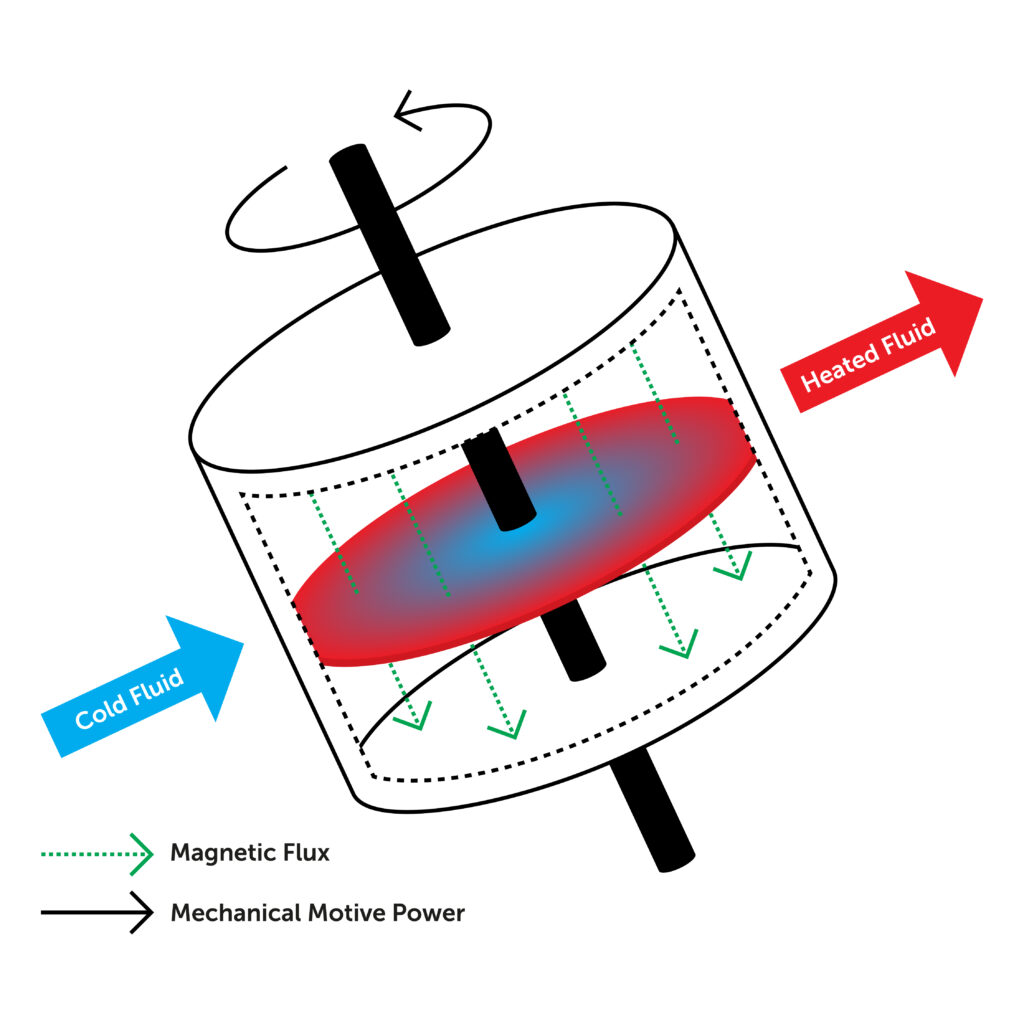
Rotaheater patented heat technology
The benefits of Rotaheaters are compelling
- Flexible
- Low Maintenance requirements
- Easy to integrate
Rotaheaters work by converting mechanical rotational power (such as from a waterwheel) directly into thermal energy with 97% efficiency.
As water drives the hydropower system, it turns a magnetic coupling within the Rotaheater, generating heat through a process similar to the way an induction hob works.
The Rotaheater then transfers this heat to water, or another fluid, which circulates through your heating system, providing a steady, clean source of warmth without relying on traditional fossil fuel or electricity supplies.
Frequently Asked Questions
Is my property suitable for a Rotaheater installation?
Properties with operational or restorable waterwheels are ideal candidates. If your property has a waterwheel or another source of mechanical rotational energy, a Rotaheater could be a suitable heating solution.
How is the Rotaheater installed?
The Rotaheater is connected to your existing hydropower installation (or any mechanical rotational power) and integrated into heating systems, such as the radiators at a property. Installation typically requires the expertise of a millwright for the mechanical setup and a plumber for the heating system integration. We can put you in touch with both.
Would generating electricity with my waterwheel save more on my electricity bill than using a Rotaheater?
A 7 kW waterwheel powering a Rotaheater can efficiently heat your home and, if your site is also equipped with a suitable electrical generation system, export surplus energy to the National Grid. By using half the energy for heating (30,660 kWh annually) and exporting the rest, you achieve significant savings on heating costs while still offsetting your electricity bill. A dual system of this sort might be expected to outperform the savings from electricity generation alone.
How does a Rotaheater compare to sources such as a heat pump as a source of heat?
Rotaheaters offers a lower upfront cost compared to heat pumps, as they do not require new radiators or extensive system upgrades. While heat pumps rely on electricity and can strain grid capacity, Rotaheaters utilise renewable mechanical energy already available on site, providing efficient, cost-effective, and carbon-free heating for suitable properties independent of an electricity supply.
How can I monitor the performance of my Rotaheater enabled system?
Rotaheater enabled systems can be monitored and controlled in realtime by you at home and remotely. An attached monitoring unit can be provided to access key performance metrics, enabling you to track temperature output, energy generation, and system efficiency. For more comprehensive monitoring, some configurations may include automated alerts and reporting features to keep you informed about system performance.
What maintenance does the Rotaheater require?
We designed Rotaheaters to have low maintenance requirements. The main components requiring attention are the bearings, which may need replacement every 3-5 years, depending on usage.
How much heat can a Rotaheater generate?
Rotaheaters models are capable of delivering from 3kW to over 200kW of heat, depending on the available mechanical energy source. The performance of Rotaheaters have been independently verified by BRE Global to ISO 14034. They can heat fluids to temperatures up to 110°C.
Can the Rotaheater work alongside my existing heating system?
Yes! Rotaheaters can be integrated with your current heating system, providing supplementary heat and reducing the load on traditional heating methods.
What is the environmental impact of using a Rotaheater?
By utilising renewable mechanical energy sources, Rotaheaters produce heat without any carbon emissions, reducing your overall carbon footprint.
How can I find out more or get a Rotaheater installed?
For more information or to discuss installation, please do get in touch with us.
Rotaheaters are highly effective at converting motive power direct to heat. ETV provides confidence to our claim.
The International Energy Agency (IEA) have highlighted how heat accounts for almost half of global energy consumption. Consumers of heat must make more investment to decarbonise heat and meet net zero emission targets.
Our Rotaheaters introduce a new and disruptive technology for how to efficiently generate heat. We understand our product performance claims are challenging in the absence of closely related technology.
Rotaheat knows that both our Rotaheater Pico and the Rotaheater Micro demonstrate outstanding performance. This is based on the evidence we have established through extensive testing under a wide range of conditions.
To offer you increased confidence in how well Rotaheaters perform, we obtained Environmental Technology Verification (ETV) by working with a professional third-party Verification Body to internationally recognised standards. The scheme involves a rigorous verification process of a manufacturer’s environmental claims, to support and promote green energy solutions.

BRE Global EU ETV Verified
ETV operates internationally to ISO 14034, providing credibility to the innovative environmental technologies needed to help achieve Net Zero emissions. The EU ETV scheme operates in Europe to the General Verification Protocol (v1.3) which fully complies with the international standard ISO 14034.
The Rotaheater Micro and Pico were verified in the framework of the EU Environmental Technology Verification (ETV) programme for the application of providing efficient energy conversion of motive power to heat in heating systems by BRE Global Verification Body on 24.01.2023. The Statement of Verification has been registered under number VN20220051 and is accessible at the following address: greenbooklive.com.
“Rotaheat is delighted to have received BRE’s ETV Statement of Verification for our clean heat products, the Rotaheater Pico and Rotaheater Micro. BRE’s rigorous scrutiny of our performance claims for our clean heat products provides heating system suppliers the confidence that Rotaheaters can help meet society’s need for clean heat.”
Robert Thompson, Rotaheat
How long will it be before COP26’s decisions turn up the heat on how we consume energy, or fades from our memories?
On the surface, COP26 set out to deliver on four simple and coherent goals. For many, it is the first goal that is front of mind: “Secure global net zero by mid-century and keep 1.5 degrees within reach”. However, it is the fourth goal that will lead to a lasting legacy “Work together to deliver”.
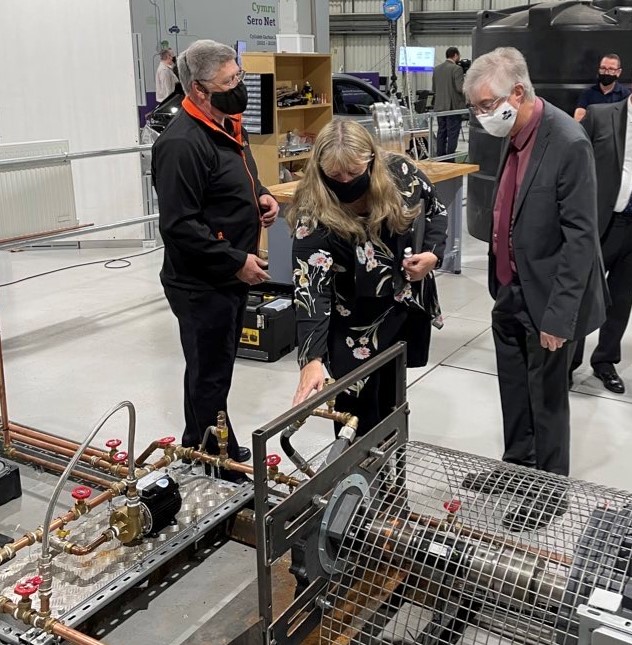
At the launch of the Wales Net Zero plan, Rotaheat’s CTO, Dr Andrew Tulloch, offers caution whilst the Welsh Minister for Climate Change, Julie James, and the First Minister of Wales, Mark Drakeford, feels the heat from a Rotaheater Pico.
This last goal recognises there is no single solution. Decarbonising our energy needs requires us to address a wide range of approaches to meet a growing demand for power, transport, and heat. With limited solutions to offsetting carbon emissions, it follows logically that there will be an increasing emphasis on zero carbon solutions, rather than low carbon solutions as part of this target. As a consequence, we might then expect further declining financial support for low carbon power and low carbon transport offerings.
As we head towards winter, it is heat rather than power or transport that is getting more attention: UK government policy to discourage new boiler installations and adopt low carbon solutions reflects a perceived absence of those zero carbon alternatives; something of a fudge, perhaps temporarily forgivable, amongst reports of fuel shortages and the increasing cost of gas.
There are existing solutions to exploiting hydro sites for generating the elusive zero carbon heat. Familiar approaches rely on first generating electricity together with the associated capital costs, including directing surplus power to resistive heating banks and integrating heat pumps into a system.
Rotaheat is deploying an alternative approach to delivering zero emission heat for temperatures of up to 110°C whilst avoiding the additional costs of a grid connection and the upheaval of installing a heat pump.
Rotaheat’s technology is highly efficient at converting motive power (mechanical rotational energy including marine and hydro) directly to thermal energy in the form of heated fluids. By avoiding the inefficient generation of electricity, Rotaheat’s technology i) delivers ~20% more useful energy in the form of heat than when electricity is first produced and then converted to heat and ii) reduces capital installation costs. The argument being, if you want heat generate heat, don’t generate electricity then heat with its substantial cost, complexity and losses.
Two core products, the Rotaheater™ Pico and the Rotaheater Micro, currently enable the generation of zero emission heat with output from as little as 3kW through to over 200kW.
With the easing of travel restrictions, we intend to resume hosting Open Days at a waterwheel in Derbyshire. Please do contact us if you have an interest in receiving an invitation to feel the heat yourself.
Contact Rotaheat (info [at] rotaheat.co.uk) to learn more and understand how easy it is to warm up your hydro project.
(First published in the British Hydropower Association‘s Spotlight magazine, Autumn 2021)
What is a Rotaheater? Understandably, this is one of the common and first questions we are asked.
The short answer is Rotaheater’s deliver heat with zero carbon emissions. Central to our patented technology is the use of magnetic fields to induce heat within a heating element.
It is worth being aware of the basics of magnetic fields to better understand a Rotaheater. A Magnetic field describes the area in which magnetic forces can be detected. Magnetic fields are central to many products we depend on every day; for instance traditional electrical generators, MRI machines and even the induction hob found in many family kitchens. They are also an important contributor to why electrical products get hot and might prematurely fail.
Magnetic fields that interact with a moving conductor form eddy currents. Eddy currents in turn are used to create both electricity and / or heat. If no electrical circuit is established, then the electrical energy degrades as heat.
Rotaheaters employ these principles not to generate electricity but to exclusively generate heat in a moving conductor, our heating element. By avoiding the generation of electricity, Rotaheaters experience only very small losses to generate heat.
That is the brief explanation of what is a Rotaheater and why they are highly efficient. For more information on Rotaheaters and our product range, please contact Rotaheat today at info@rotaheat.co.uk.
Rotaheat knows that both the Rotaheater Pico and the Rotaheater Micro demonstrate outstanding performance. Our knowledge is based on evidence resulting from extensive testing under a variety of conditions intended to simulate what you might face. But what is the climate impact of a Rotaheater?
There is no doubt that decarbonising our energy usage, and reducing our climate impact, will become more challenging. In some areas there are simple solutions, e.g., switch to an electricity supplier committing to deliver electricity from renewable sources. In other areas, such as to decarbonise our heating needs, there may be limited practical alternatives without changing behaviours or energy systems.
But how do you forecast the climate impact of changing, maybe by adopting a new product? A simple question, complicated by needing to understand the impact across a product’s life that stretches from cradle to grave. Understanding the cradle to grave impact requires deep understanding of a supply chain from digging materials out of the ground, producing and distributing the product, operating the product and disposing of the product. This need to take a total life-cycle view makes it hard to judge which product has the least climate impact. The climate impact is not always obvious. As a challenge, does fresh broccoli or fresh lettuce have the lower climate impact? And does solar PV or nuclear power have the lower climate impact? The answers are below.
Rotaheat considered this, with the support of EIT Climate-KIC and Impact Forecast, by comparing the climate impact of a Rotaheater Pico powered by a water wheel against a conventional boiler powered by gas. The analysis is startling. Both solutions carry out the same function, delivering about 98,000kWh of heat and meet the typical demand of 4-5 homes.
How each solution delivers the function leaves a markedly different climate impact. Both solutions leave an impact; various metals are mined, processed and transported and needing to be disposed of. The material difference is during use. Natural gas consumed by the boiler annually emits 22,799kgCO2e with the Rotaheater Pico directly emitting zero emissions.
Annually, the emissions associated with gas boiler are about 22,754kgCO2e more than a Rotaheater Pico. According to Impact Forecast the Rotaheater Pico provides a “significant and positive impact”.

Verified by Impact Forecast
To put that climate impact into perspective, 100 installations incorporating a Rotaheater Pico would result in the annual equivalent of:
- avoiding cars driving a distance the equivalent to around the world 281 times, or
- flying 22,986 fewer passengers between New York and London, or
- converting 956 EU households to using renewable electricity.
We think that is quite an impact, all without changing your heat usage or behaviour.
But what is the impact of the larger Rotaheater Micro? Contact Us to find out.
And the answers? fresh broccoli and nuclear power. According to Impact Forecast, fresh broccoli has an impact of 0.6 kgCO2e while fresh lettuce has an impact of 3.4kgCO2e. By comparison per 100MJ of energy produced, solar PV contributes 1.9kgCO2e compared with nuclear power contributing 0.3kgCO2e.